
Glaucoma Screening ExaminationGlaucoma Diagnostics
Glaucoma screening / early detection
Glaucoma is an eye disease that usually progresses chronically over many years, goes unnoticed by patients for a long time and can lead to blindness if left untreated. Glaucoma occurs more frequently in older age (from the age of 40). The most common form of the disease, primary open-angle glaucoma (POAG), usually affects both eyes but initially causes no early symptoms. Later, untreated patients notice a marked restriction of the visual field or even loss of central vision in the more severely affected eye.
The German Ophthalmological Society recommends that people aged 40 and over who do not have glaucoma repeat glaucoma screening every two years. For people over 65, glaucoma screening should be carried out annually. People at risk should have an annual eye examination from the age of 35.
Risk factors: Age > 40; first-degree relatives with glaucoma; short-sightedness; diabetes mellitus; vascular factors: migraine or cold hands and feet.
Most glaucomas are caused by increased intraocular pressure, which damages the optic nerve. However, there are also glaucomas that develop without increased intraocular pressure (normal-tension glaucoma). On the other hand, there are cases of moderately increased intraocular pressure without any signs of visual impairment or optic nerve damage (ocular hypertension).
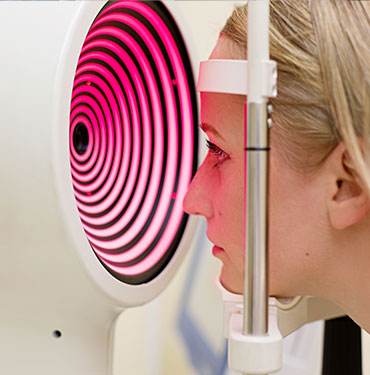
Intraocular Pressure Measurement
Increased intraocular pressure is the most important risk factor for the development of glaucoma. In our practice, intraocular pressure can be measured both contact-free by non-contact tonometry and by applanation using Goldmann contact tonometry.
Pachymetry / Corneal Thickness Measurement
Knowing the central corneal thickness is important because it directly influences the measurement of intraocular pressure. The thinner the central cornea, the higher the risk of developing glaucoma. The measurement is contact-free and painless (OCT, IOL-Master, Keratograph, Pachycam).
Visual Field Examination
Visual field testing is a central component of glaucoma diagnosis and follow-up. Up to 40 percent of the nerve fibres may already have been lost before the first visual field defects become detectable.